Giant corona problems are revealed for the X-ray eye of Chandra if it looks at supernova remnants and filaments of galaxy clusters! If the detected iron atoms are ionised e.g. twenty five times thermally, we have again the unsolvable solar corona-problems in higher and higher dimensions:
Why is the heat energy not lost in microseconds at these 10-100 million Kelvin?
Why are the ten sunmasses of Cassiopeia A and the one billion sunmasses of Centaurus cluster and that of all these celestial bodies organized in filaments? The origin of the name "Krab" of M1 early showed these "legs".
Why can all of our detectors not find a temperature-radiation? The mass would be more than enough for a perfect Planck-radiation.
Why are the higher ionized iron atoms farther from their source?
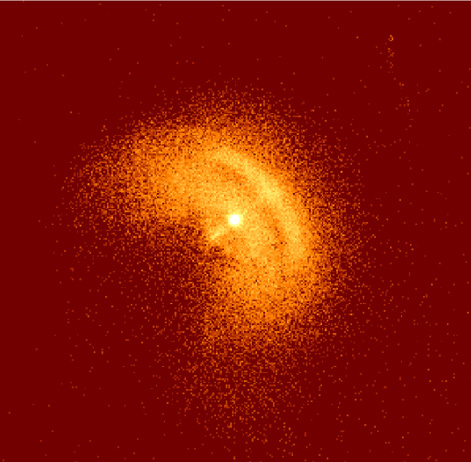
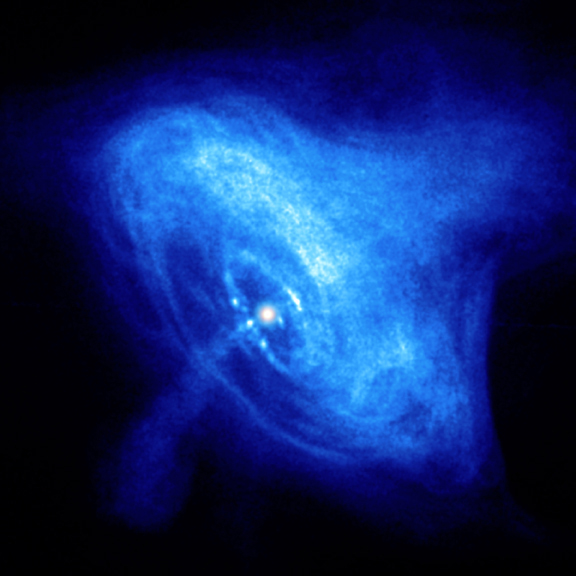
These pulsars should have misaligned rotational and magnetic axes. If the magnetic axis just points us, we should see a pulse. But the X-ray pictures clearly show that the magnetic axis (the jets) are identical to the rotational axis in both pulsars, but the pulsars pulse. Moreover, the identical two axes do not point us, but we see them.
Neither the iron ions in the solar corona, nor those in the supernova remnants nor in the galaxy clusters are in the plasma state of matter.
Chandra shows them - similar to the electrons in the TV-beam - in a filament-state of matter i.e. in the fifth state of matter. Look also "The Electric Universe"!
Not long ago the Chandra satelite took a picture that made its way through the press. It raised questions which are difficult to answer, even with "modern" astrophysics.
A lot more simple is the answer I provide in my book "The Electric Universe". I have written this page to create a forum for scientists as well as for amateurs. So please do not hesitate to join in and take part in the discussion.
Much more information about Chandra containing links to other sites and scripts are to be seen in the Links & Infos - page.
By Dipl. Phys. Dr. Ing. L. Koertvelyessy,
Candidate of the Hungarian Academy of Sciences
Observatory Kleve, Germany
This paper predicts those pictures which will be seen by Chandra, based on the idea
that the Universe is formed not only by the one but by the two forces of infinite
radius: by gravity and by the electric force. Therefore, please do not be disturbed
by new expressions. They will be probably quite common in some years.
See details in my book The Electric Universe.
Supernova Remnants
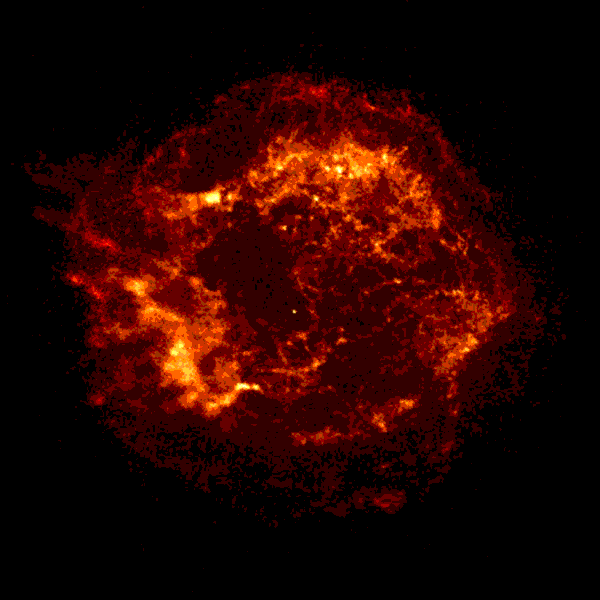
Let us analyze Chandra’s first picture: the supernova remnant (SNR) of Cassiopeia A.
This beautiful picture consists of about 190 of finest filaments.
Prediction: All new SNR pictures of Chandra will consist of about 100 filaments.
I predicted this picture two days before its publication via an e-mail sent to
Prof. V. Burdyuzha at the Moscow Academy of Sciences.
What is the cause of the emission of X-ray of a SNR?
ROSAT image (earlier, less detailed)
Chandra image (fine filament structure)
The German X-ray telescope could show only fewer details one decade ago.
Chandra’s fine filaments totally exclude a collision model.
These filaments are not pressed to the body of the SNR by any hindrance.
Brown Dwarfs
Chandra will show that young brown dwarfs emit X-ray irregularly,
similar to young stars, and also from their two jets.
The cause is positively charged matter falling into the star during formation.
Abell 30
Chandra will show that only this white dwarf and its emitted helium fingers emit
X-ray. Gamma-ray bursts (GRBs) are electrostatically exploding white dwarfs
in our proximity.
Comparison of Explosions
The table below compares the differences in the types of explosions.
Property
Supernova
Gamma Ray Burst
Exploding body
Big star
White dwarf
Mass
> 7 solar masses
1–7 solar masses
Cause of explosion
Neutron star heat
Cooling of positive charge
Main energy export
Neutrinos
Gamma rays
Remnant temperature
3 K
3 K
Table from my report at the UNESCO Science-World Conference,
Budapest, July 3, 1999.
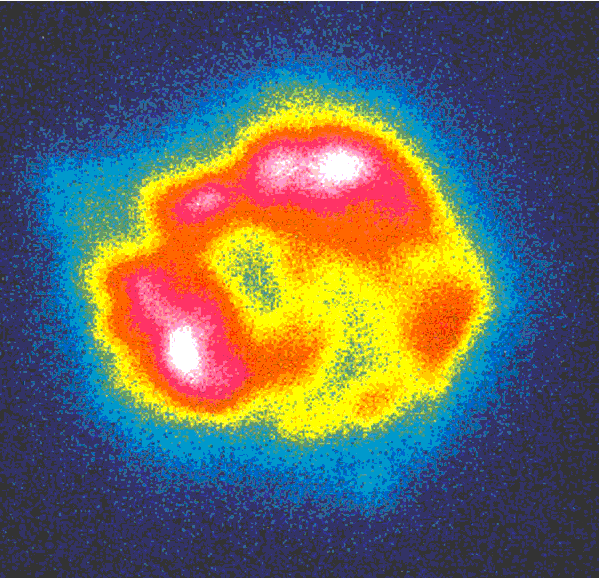
The image you see shows Chandra's first picture, the SNR of Cassiopeia A. Now move your cursor to the image. Now you can see the same nebula-picture shot by a German X-ray telescope almost a decade ago.
The X-ray was allegedly emitted by high temperature due to the collision of the SNR with the interstellar matter. But, already the ROSAT-picture was not consistent with this collision-model because ROSAT clearly showed that the emission of edges of the SNR is less intensive than those of the inner regions (white). Chandra also confirms this inconsistency. But now, Chandra´s fine filaments totally exclude a collision! These filaments on the edge are similar to the antennas of a beetle which fly free in the air. These fine floating filaments are not pressed to the body of the SNR by any hindrance. The whole body of this SNR consists of about 190 filaments (I predicted 100 see table 1), they would clearly show a hindrance if any existed. (Also the spot-penumbra or the corona contains 100-200 filaments. Why ? I do not know.)
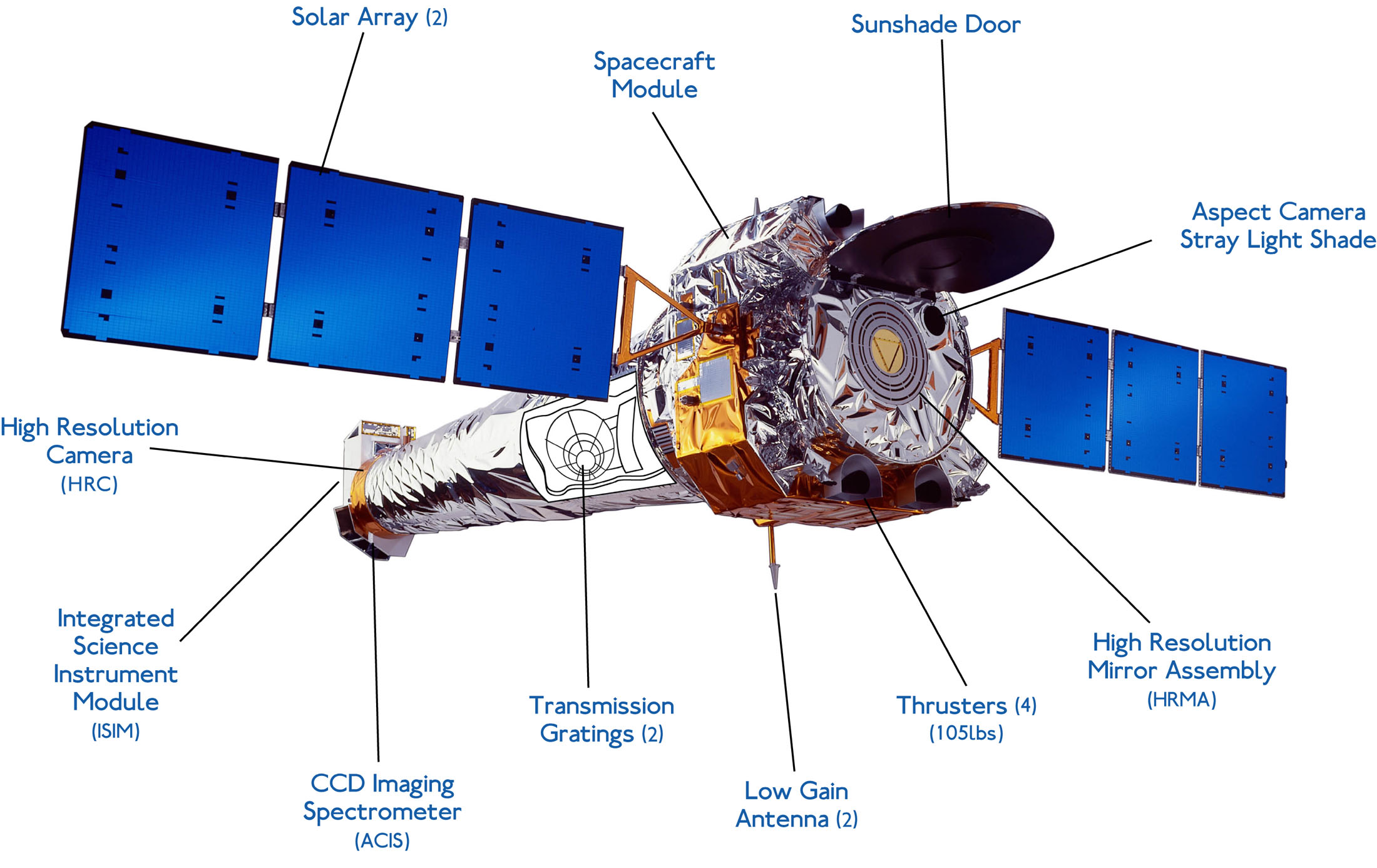
Here you can find more information about Chandra, mostly collected from the NASA server. Furthermore, I've added a personal script from July '99, that predicts what Chandra is likely to see in the future! In order to download the script you can choose from different formats. Click on the formats in the download box for Post Script or PDF. Choose HTML if you don't have the Acrobat Reader, yet. Download the latest version of the
Acrobat Reader
here.
Here are some links to pages which contain infos about Chandra:
Born and raised in 1932 in Budapest. He worked first as a physicist for high-temperature measurements with thermocouples and later as a scientist in high-temperature process technology in industry. He became a recognized expert in thermocouples and oxygen probes; his scientific book on thermocouples is now in its third edition (6,000 copies).
After escaping communist Hungary in 1971, he worked for Degussa in Hanau before being recruited by Ipsen in Kleve, Germany. In 1983 he founded his highly successful company thermo-control Körtvélyessy GmbH. After more than 30 years, he handed the company over to his son and returned to Budapest in 2007.
He passed away in 2016.
Entrepreneur
Dr. Körtvélyessy founded
thermo-control Körtvélyessy GmbH
,
where some of the world's best thermocouples and oxygen probes are manufactured. His patented thermocouples and oxygen probes are based on his discovery of a new thermocouple law — which also forms the foundation of his “Electric Universe” model.
Started in 1983 as a small one-man company, he used his research to develop innovative thermocouple designs. The brand is now renowned worldwide for the exceptional quality of its products.
Scientist and Astronomer
He was a candidate member of the Hungarian Academy of Sciences since 1991. Married with four sons, his “hobbies” are easy to guess: as shown in the photo, he owned a 360 mm telescope in his home observatory. On every sunny day he observed sunspots, flares, and prominences — observations that deeply informed his Electric Universe theory.
Key Publications
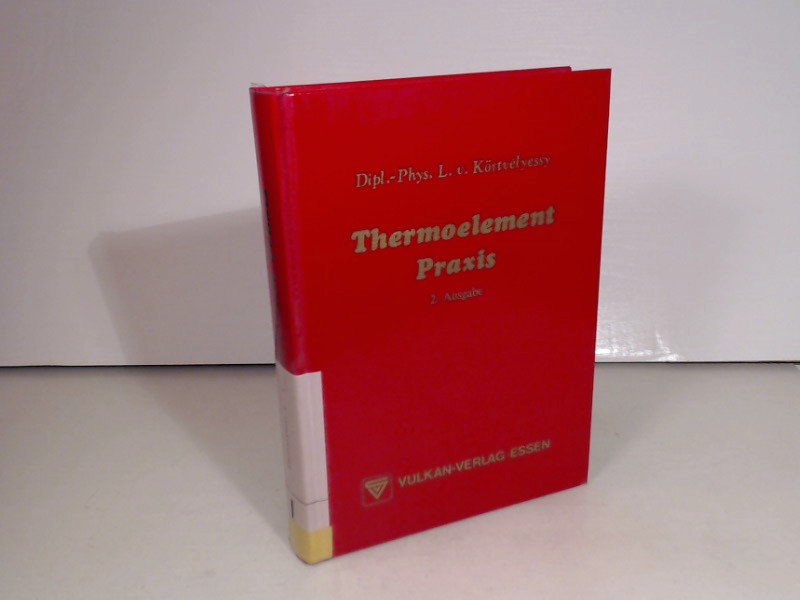
Thermoelement-Praxis (multiple editions, starting 1981; standard reference work on thermocouples, with later editions co-authored and updated up to the 4th edition around 2015 by László Körtvélyessy and Daniel Körtvélyessy). Published by Vulkan-Verlag.
The Electric Universe (1998, EFO Kiadó, Budapest; ISBN 963 8243 19 8). A comprehensive presentation of his electric model of the cosmos, including the role of electricity in solar and stellar phenomena.
Contributions to conference proceedings, e.g., "Electric magnetars" (AIP Conference Proceedings, 2000), expanding on ideas from The Electric Universe.
These works represent the core of Dr. Körtvélyessy's scientific legacy in high-temperature measurement technology and his independent cosmological theory.